


"As Duas Faces da Noite" (The Two Faces of Night), created in 1990 by the Portuguese contemporary artist Anabela Faia.
“There can be too much truth in any relationship.”
— The Dowager Countess of Grantham, Downton Abbey
On Losing Your Voice
When I create these newsletters, I often rely on AI to generate images. I’m no visual artist. And in recent months, I’ve leaned on Claude.ai to help refine my writing, smoothing out the bluntness, trimming the excess. Useful, yes. But it’s made me think: the more we hand our true voice to something designed to average out collective meaning, the more we remove the depth of what we want to say, and risk losing what makes our voice distinctly ours.
The same can be said when we avoid having uncomfortable conversations. The cost of silence often tarnishes or relationships with others and can disconnect us from ourselves.
Likewise, when we don’t have the difficult conversation about our own needs, especially when it comes to putting our advance plans in place, our intentions may get framed by the voice, and often the grief and insecurity, of another.
This is what I am focusing on in this newsletter – the price we pay for avoiding difficult conversations with others, but mostly with ourself.
Many of you contacted me after my recent newsletter about fading relationships, so I thought it important to continue on that theme, to offer some steps toward understanding what it is that you want for yourself, and how having the uncomfortable conversations will help you get there.
When Silence Becomes a Choice
In advance planning, and in everyday life, we often avoid the uncomfortable truth of keeping accountable to what matters to us. Maybe you don’t know how to identify your needs and end up feeling unmet, unheard, unseen. Maybe you resist difficult conversations, softening your words to avoid discomfort. Maybe you find yourself accommodating others until there’s nothing left of your original thought. Maybe you hadn’t realised until now that your life has been lived so far removed from who you truly are.
So how do you create change?
Difficult conversations take many forms:
• Saying what you need - which first requires knowing what you need.
• Addressing misunderstandings and honestly asking what part you played.
• Identifying the uncomfortable realities of fading relationships or shifting responsibilities.
• Navigating others’ wishes that may clash with your own.
In my many years working in HR, I’ve seen first-hand the destruction that avoidance causes. Stemming from ego versus expertise, the fear of being caught out, or of being seen as not knowing what you should know, often leads to frustration and avoidance in having the honest conversation about what each party needs. One party thrown in at the deep end, afraid to ask for help. The other despairing that what feels obvious to them has become a chasm between them and someone who simply hasn’t been there yet.
As many of us navigate the loss of parents and loved ones, I’ve seen grief tear families apart. Not because people felt too much, but because no one was given the space to acknowledge it. One person takes charge without invitation; others feel unseen; the practical and the emotional collide. And yet, if everyone did speak their truth, would it deepen the wound, or would it finally allow the rawness to heal?
I’m currently studying a Diploma in Dispute Resolution and Mediation with UCD, and I’ve been reading Kenneth Cloke’s The Magic in Mediation - a book that invites us to examine the questions we ask of others and the questions we must ask of ourselves. One thought-provoking concept he poses I want to share with you:
If this were the last conversation you were going to have with each other, what would you want to say?
This isn’t about death and dying. It’s about recognising that avoidance may one day quietly remove the opportunity for a conversation to happen at all. Are there matters important to you that you’re afraid to discuss? Can you get to the core of why?
The Hardest Part Is Starting
The hardest part of any difficult conversation is rarely the conversation itself, it’s the moment before it. The hesitation. The fear of saying the wrong thing, or of opening something that can’t be closed again.
But the conversations we avoid don’t disappear. They go underground. They resurface as resentment, as confusion, as conflict at the worst possible moment, when someone is already burnt out, grieving, overwhelmed, depleted.
It doesn’t have to be a bereavement for grief to occur. Clashing opinions that harden into avoidance. Differing needs leading to journeying different paths in life. In bereavement, families unable to bring comfort to each other’s grief, so that the relationships with the living become casualties alongside the person who has died. That’s why honouring our own needs and stepping up to face the discomfort, may bring the greatest freedom.
What’s the worst that can happen if you got clear on your needs and expressed this to others you want to meet you where you are at? Possibly clarity and release of the burden. How freeing.
Having a framework helps. The prompts below aren’t just a planning checklist, they’re a way of beginning. Of giving yourself permission to know what you want before you’re asked to say it under pressure. When you’ve already sat with the question “who do I trust with this?” or in consideration of advance planning, “what would I need if I couldn’t speak for myself?”, the conversation with a loved one or a professional becomes less daunting. You’re not starting from nothing. You’re sharing something you’ve already thought through.
So if there’s a conversation you’ve been putting off: with a parent, a partner, a sibling, a colleague - consider using these questions as your starting point. Not as a script, but as a way in.
What Actually Matters to You?
This is the starting point. Not what you think you should want. Not what’s easiest to say. What actually matters.
A few practical prompts to help you articulate this for yourself, and for those who may one day need to support you:
Your needs and feelings. The Non-Violent Communication framework is a useful starting point: feelings and needs list
Your people. Who is best placed for what? The friend who will speak honestly with you to help you get perspective. The organised friend who can help you get things in order. The steady presence who simply sits with you. These roles don’t have to fall to the same person.
Your legacy. Beyond possessions, what do you want to continue? Relationships nurtured? A way of living? Something protected or passed on?
For Advance Planning:
Your comforts. If someone had to step in and care for you tomorrow, what would they need to know to ensure your comfort? Do they know your preferred food, drink, room temperature, surrounding noise, company of people? The small things matter more than we expect.
Your healthcare wishes. Does your GP know what treatments you’d decline? An Advance Healthcare Directive ensures your preferences are recorded and honoured: decisionsupportservice.ie
Your estate. If conflict among those you love feels likely, consider appointing a solicitor or trusted friend as executor. A practical decision made now is a gift to everyone later.
How Advance Planning Will Help
I recently wrote about the new public awareness campaign in Ireland about Advance Planning created by the Decision Support Service (DSS) to encourage the public to create Enduring Power of Attorney and an Advance Healthcare Directive.
This is a welcome campaign to get people talking about what matters for them in their care and dying. Yet while legal documents are the foundation of advance planning, they are not the whole house.
The DSS campaign rightly focuses on the legal layer. My work through Living Legacy exists to cover everything that surrounds and supports it: the personal, emotional, relational, and practical planning that turns good intentions into a whole plan.
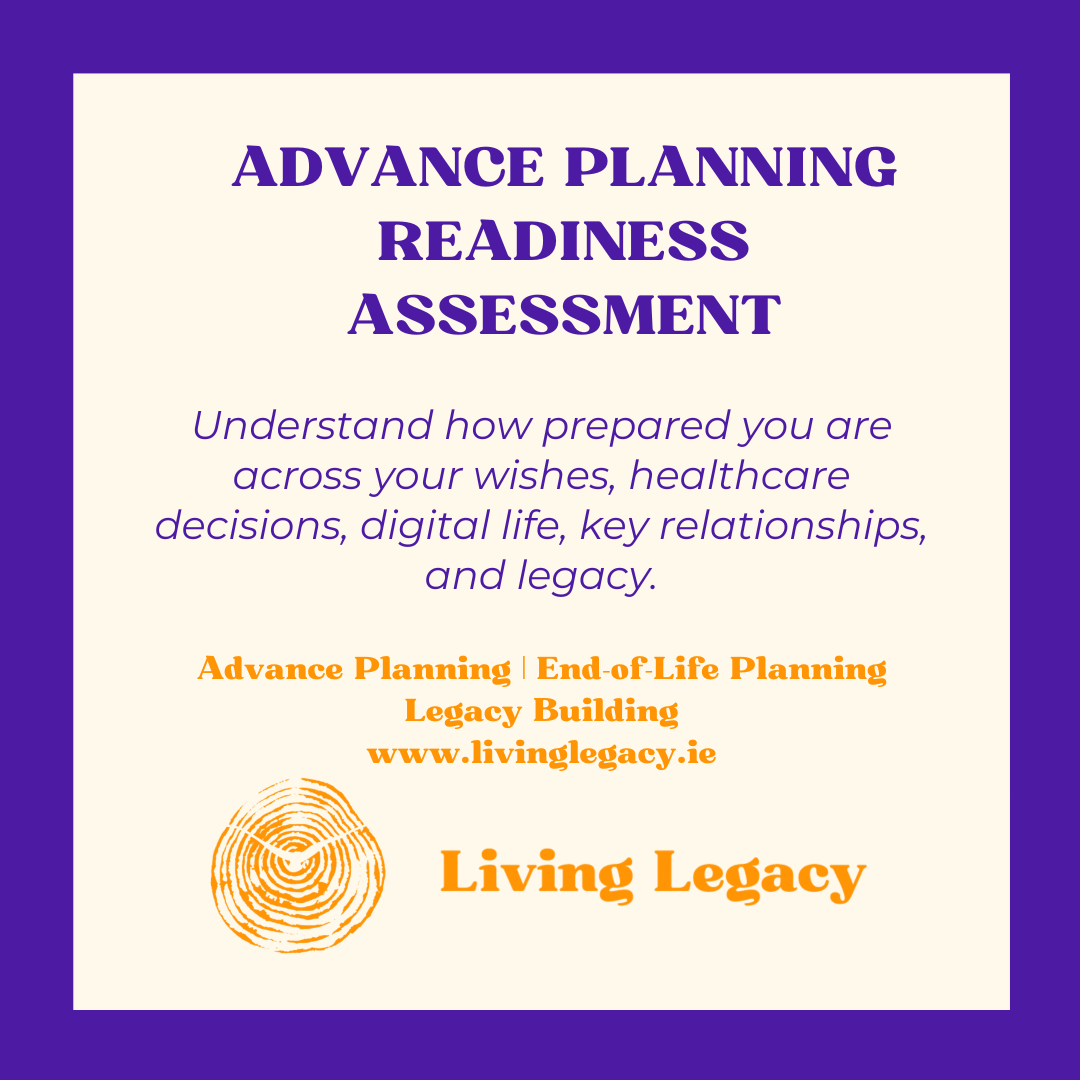
The Living Legacy Advance Planning Readiness Assessment is a free, quick tool that gives you an honest picture of where you stand today: what you’ve already put in place, what’s still missing, and where to focus your energy next. It takes just a few minutes, and it might be the most useful few minutes you invest in yourself this year.
Because knowing what matters is only the beginning. Writing it down, putting it in place, and making sure the right people know, that’s the work. And it starts with one honest question: how ready are you, right now?
Whether it be having that difficult conversation with others, or in fact having that difficult conversation with yourself. What is it that you need, not only in your care and commemoration, but in your living and in relationship with others.
Where Do You Start?
If this newsletter has prompted you to pause and reflect, that’s exactly the point. But reflection without action changes nothing.
If a difficult conversation has been sitting at the back of your mind as you’ve read this - with a parent, a partner, a sibling, or someone you care for - let that be your sign. Use the prompts above to find your footing. You don’t need to have all the answers before you begin. You just need to begin.
100 Days
This month marks ten years since I completed my first 100 Day Challenge - a deliberate effort to break old habits and build new ones. This round, I’m focusing on exercise and writing, in an effort to get to my true voice, and my ideal health, to how I want to be in this life. Both require showing up consistently, even when it’s inconvenient.
What would you change in 100 days, if you committed to it?
One step. One habit. One conversation you’ve been putting off. That’s enough to start. And if you'd like some support with it all, just reach out to me at [email protected]
Jen x
Jennifer McConnell, Founder, Living Legacy (www.livinglegacy.ie)




Responses