There is Life After a Stroke
Today is World Stroke Day.
Twelve years ago my father had a stroke. It destroyed his left peripheral vision, and in doing so it took three things that had organised his life: his work, his driving, and golf, a game he had played since he was a young man.
Twelve years on, he lives with vascular dementia, a likely result of that stroke. We are blessed that his memory and his awareness are still reasonably good. Some families lose those much earlier than we have. What the dementia took away was his love of music.
In recent years he has also had several transient ischaemic attacks, TIAs, which are a warning sign that another stroke may be coming. Each one shifted the picture a little. Each one made the need for a plan more pressing, not less. When you are living with a condition that can change without warning, you learn quickly that planning is not a single event. It is something you keep returning to.
In recent months his ability to recognise and actually listen to music - even if only for half a minute - has slowly started to return. That is the unusual twist, because music is so often the one thing to remain with those living with dementia. Families are told to keep singing, keep the old songs going, that the part of the brain that holds music holds on longest. In our house it went quiet. For a few years there was little music as it seemed to be a sensory overload for my Dad to absorb.
Then, in recent months, he began to get curious again about music. Especially through one song and one singer: Ralph McTell and Streets of London. He asked to listen to this beautiful song repeatedly, even requesting I play it when I was hosting the Lunchtime Miscellany on Near FM over the Summer.
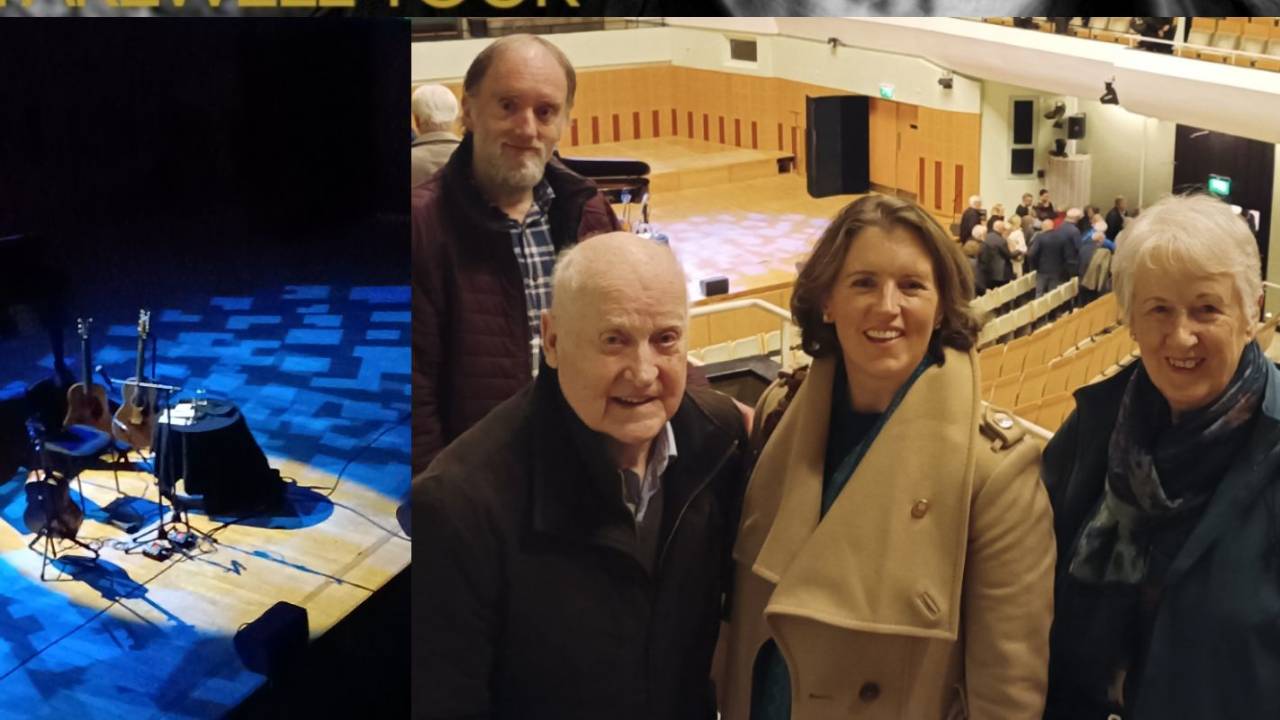
In July we learned that Ralph McTell was doing a farewell tour. Himself 82, still touring his songs. My father was insistent that we get tickets, and that he wanted to see him in the National Concert Hall. So we did, and last night we went, all of us together.
We were cautiously optimistic. His attention span is short now, and most evenings he wants his bed straight after dinner, by seven o’clock. A full concert, with an interval, would be a long night for him by any measure.
But he was looking forward to two things, not one. He wanted to hear Ralph. He also wanted to be back in the National Concert Hall, the place he and my mother went on dates, on and off, for years. Regular nights out that stopped in recent years, when he lost the capacity to enjoy a full musical performance.
Last night, he loved every minute of the experience.
He sat captivated by Ralph's beautiful tone of voice and his songs, eagerly awaiting Streets of London to enjoy hearing it live. At the interval my Dad chatted with the people sitting near him, and they chatted back. He was, for the length of an evening, simply a man at a concert with his family, rather than a man visually impaired, living with vascular dementia, being cared for.
Last night was so so special for me, for us all. What made it more than a good night out was that we enjoyed it together, and we got to watch Dad enjoying being there.
Today is World Stroke Day, and so I want to say something plainly.
There is life after stroke. It is often a different life, and it asks a great deal of everyone in it, but there is life, and it is worth having.
It does not happen on its own, though. Stroke recovery and the long years after it need support, and they need it in more than one form. Medical support, kept current as the body changes. Emotional support, for the person who had the stroke and for the people who care for them. And social support, the ordinary human kind, the visits and the evenings out and the friends who keep asking.
Stroke does not only happen to one person. It happens to a household, and to a family, and the support has to reach all of them.
The plans have to change as the years go on, too. The supports that worked in year one are not the supports that work in year twelve. What made last night possible was small and practical: knowing how much energy he would have, knowing he would need to be home at a reasonable hour, choosing seats where he could see, having a family around him who all understood the same things without a word being said, and knowing that he loves Ralph McTell and why.
Most of that information lives in the heads of the people closest to him. It works because we are all still here to carry it.
And it is why having his plans in place has been so important, especially through the TIAs and the years of small changes. It means two things.
First, we can care for him effectively if things get worse. We are not starting from scratch in the middle of a crisis. We know what he takes, who to ring, where things are, and what the household needs to keep running.
Second, and this matters more to me, we know his wants and needs from his own perspective. Not what we assume he would want. Not what we would choose for him. What he has actually said, while he was well enough to say it. That takes a great deal of guesswork and second guessing out of the hardest moments, and it means the decisions we make are his, carried by us.
Which brings me to the reason I do the work I do, and to something you might want to do this week.
When a stroke or any sudden illness arrives in a family, the practical questions arrive with it. What medicines does he take, and at what dose. Who do we ring first, and who second. Where are the documents. What does he actually want. What does he love, and what would make a good day for him. Those questions are much easier to answer when someone has written the answers down, before a crisis, in ordinary language, while everyone is well enough to think.
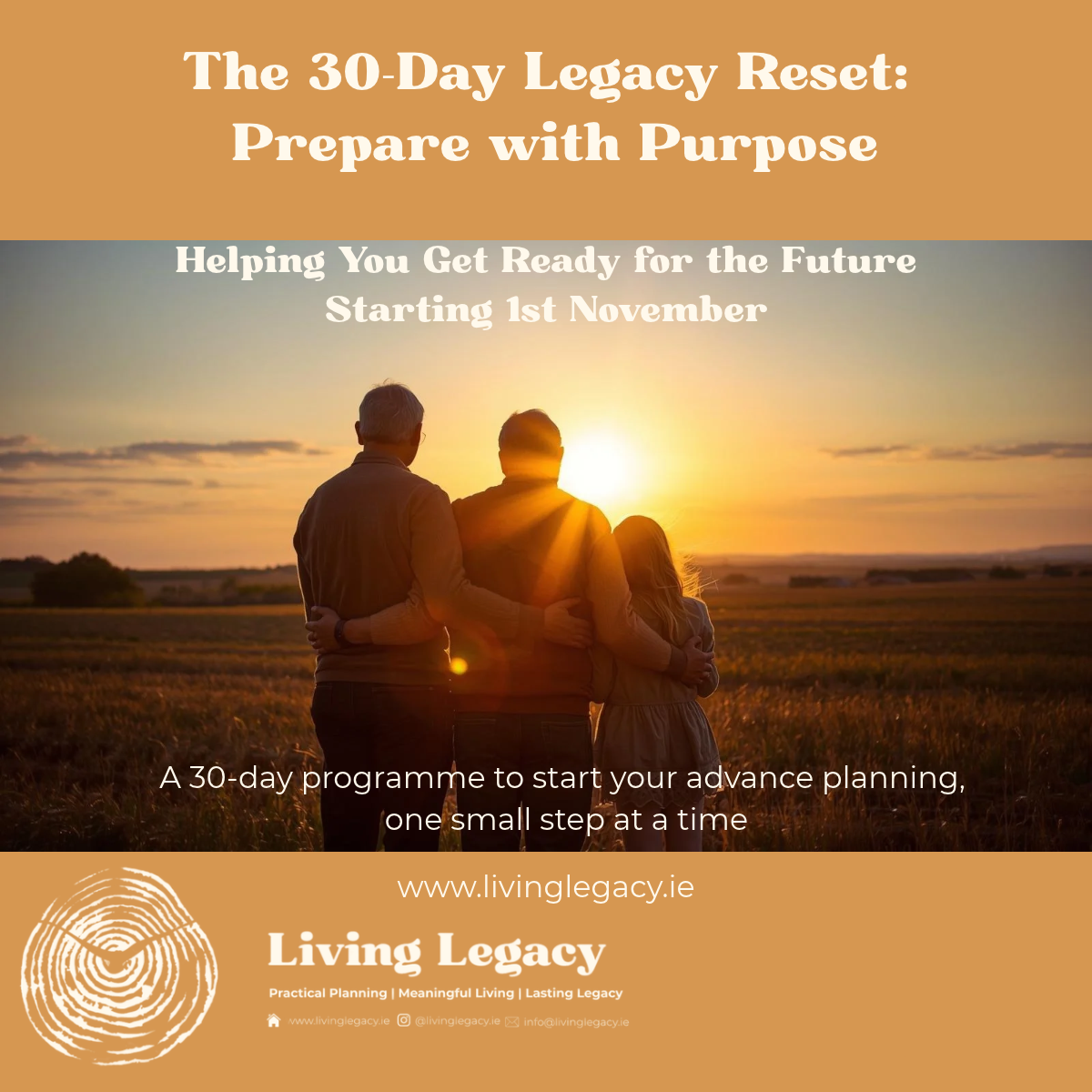
That is what The Legacy Reset is for. Thirty days, one small action a day, about fifteen minutes each. Nothing dramatic. An emergency contact list. A medicines list. A folder where things can be found. A photograph that says this was us. A conversation started, rather than postponed.
It is not legal or financial advice, and it is not meant to be. It is the preparation that makes a professional meeting useful, and that makes a difficult week in a hospital corridor a little less like a search party.
The Legacy Reset 30-Day micro-programme is available from Sunday 1st November, and you have access for 60 days, so you can work at your own pace. Details are available and you can book now at https://www.livinglegacy.ie/legacyreset
Before I finish, one word of thanks.
My mother has devoted her care and support to my father through 57 years of marriage, and especially through these last 12, as his health became more vulnerable. Last night, in a small way, she got her date night back at the National Concert Hall.
There is life after stroke. Bring the supports, and bring the music. Thanks to Ralph McTell for his music and his stories that gave us such a wonderful night together.
Join our Living Legacy Newsletter
Join our mailing list and learn how to build and live your legacy.
We take your privacy very seriously & will only send you the Newsletter and supporting emails. Read our Privacy Policy
Author